Sneak preview of some of my new nest boxes

I have been working on a range of new nest boxes for this spring to bring really great pictures of birds raising their families. I will be writing in more details about these boxes on my website in the coming months, but today I managed to get two of the newly adapted boxes up in the garden, with cams inside. They are not wired back to the house yet as I will swap things over from the feeders when the nesting season kicks in.

The first box I adapted is a HandyKam nestbox. I want to get a really close-up, low angle view inside, so have added a section onto the side of the box so I could get a camera mounted low and close to the nest. I have lined the nest box with bark too, so give a more natural look. I am really pleased with the image I got from the cam, so mounted the box back up on a tree in the same position where I have had success for the last two years.

The second box I have adapted is actually a sparrow terrace. It was a prototype that was sent to me by Ark Wildlife. As there was lots of space, I took an internal wall out, moved it along to create a slightly larger nesting chamber and a smaller chamber for the camera. Again, I have lined the box and set the camera low down, close to the nest.  I have put this box up on a tree further up the garden, in a new position.

I have another three cameras mounted in nest boxes and another three to go up that aren’t quite finished yet. I will then have to keep my fingers crossed that they are occupied. If they are, then I hope to live stream some great intimate views of the families being raised!


My Peckish Prize!

Last week I was delighted to receive my prize from Peckish Bird Foods. I had won their competition to name the two bird characters on their TV advert. My prize was a Panasonic Lumix DMC-TZ18 camera. It is a fantastic little camera and will be great for photographing all the projects for my blog and website.

The company have also sent me some products to trial in my garden and with my Wildlife Club. These included some of their feeders and a selection of food…..

These food come in great little pouches, either with a zip-close top…

… or this really handy spout…

This makes it much easier to fill up a feeder. I filled the feeder I had been sent with the 5 in 1 Bird seed pack…

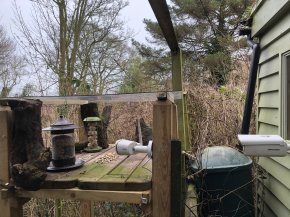
I decided to put this feeder up on a tree, right next to the hedge, quite far up my garden, above the waterhole cam. This means that,I can alternate between this feeder and the waterhole cam on my live stream, using the same cable. As the ports on this Peckish feeder are plastic, I decided to put it inside a spare squirrel cage I had. I mounted the cam onto the tree, facing the ports and the tray. You will be able to see it on my live streams:

The second feeder is a larger version, with more ports. I filled this one with the ‘Winter Warmer’ seed mix and hung it from my Magnolia tree. It is on quite a long chain, so hopefully the squirrel won’t be tempted!

I think this is a really attractive feeder and the great thing is that the lower ports can be rotated so, instead of being open, they have a grid making the feeder suitable for nyger seed. The top ports can be switched for the same… they simply un-clip and you can clip in the alternate style; a great idea! These photos of the feeders were all taken with the new Lumix.

A big thanks to ‘Peckish’. The kids at school will be delighted with their feeder and food too… we will set it up in the grounds tomorrow.

WildlifeKate Big Garden Cam Birdwatch!

Next weekend is the RSPB Big Garden Birdwatch, where they everyone is asked to make a note of the bird species they see in their garden, or local park, for just one hour. Results are the submitted to the RSPB. The results help build up a picture of the bird population in the UK. Over 600,000 of us took part in Big Garden Birdwatch 2011 and counted over 10 million birds. The RSPB website summarises the results from last year’s birdwatch.

House sparrows retained top spot for the eight year running, with an average of four seen per garden.

Starlings and blackbirds swapped positions on the 2011 leader board, with starlings now at number two and blackbirds at number three.

Starling sightings increased by a quarter since 2010, but their numbers are still down from when Big Garden Birdwatch began in 1979.

I always take part, but this year, I wanted to do something a little different and also use my live cams as well in some way. One of my Twitter followers, Paul, suggested I could use my live cams and get people to tweet about what they had seen and that got me thinking! I have created a page on my website about what I plan to do next weekend and how you can get involved too.

For more details, take a look at this page on my website.

Basically, I am going to have two challenges:

On Saturday, I will do my hour birdwatch and log all the species I see and publish these on my website. I am also going to attempt to get a decent photograph of every species that visits my garden. I will upload all of these into a ‘Garden Birdwatch 2012′ set on my Flickr account. If you would like to do the same, then upload your photos into a set on your Flickr account and email me the link. I can then put a slideshow of your photos on my website. It would be good to share them in this way and interesting to see what different species others have seen.

On the Sunday, my live cameras will be focused on the bird feeders. Over the hour between 11am and midday, I am asking people to join me watching my live cams and we’ll see how many different species we can spot on the cams. I will attempt to screen capture them all! We can use twitter to log our results using the hashtag symbol;  #WKcambirdwatch

It would be great to share this event next weekend with you and I look forward to seeing what we can see. This weekend I have had three bullfinches returning to the garden and the blackcap is still around. It would be great to get him on my count!

I set up a Feeding Station & Nest Box Camera System for an Infants School

I undertake all sorts of consultancy work, but I must admit, the kind of work I did today is one of my favourites! As a qualified teacher, the great advantage for schools to get me in to set up feeding stations and camera nest boxes, is that I can also take groups of children, teach and take an assembly! The school that I worked at today school had raised some funds and were keen to have a nest box camera. They chose one from my shop… the side nest box that I had success with last year with a family of great tits. They liked the idea of the side-on view and on a visit I made to the school last week, I could see a potential tree for it.

They were also keen to get some bird feeders up in school so they could do the Big Schools’ Bird Watch and teach the children more about the wildlife that can be attracted into the school grounds. They had little idea about what to get and where to put it, so I organised the whole thing and stocked up on the budget they had given me!

I arrived at school with a car load;….. nest box and camera system, five bird feeders and a good range of food, hooks and chains to hang them, a ladder, all my tools and just about everything else I could lay my hands on that I thought I might need!

My morning started with assembly, where we looked at all the feeders I had bought and the different types of food. They already had a super display up using the resources from the RSPB, FREE to all schools who sign up for the School’s Bird Watch. I showed them the nest box and the camera inside. I was able to show them my website and we looked at all the pictures I took in my nest box last year, so they were able to see my great tit family growing up. There was much excitement and lots of questions.

The children returned to the classroom whist I started the task of putting up the nest box and wiring it all back into to school, through a classroom and to a lovely big TV in a little area just to the side of their school hall. It is going to be a fantastic place for the children to watch their nest box as it is in such an accessible area. Of course, today, it had chosen to pour with rain. Armed with drill, and screw driver, I eyed up the tree I had chosen. It was well positioned and had a nice flat area of trunk, perfect for the nest box. The other advantage was that it was a good climbing tree… I would be able to climb up to mount the box rather than relying on  a ladder. The children watched out the window as I expertly (of course!!) climbed up and mounted the box onto the trunk. I then ran the cable from the tree, across to a roof corner and then into school through a hole drilled in the wall. With the cable clipped along the wall, all the way back to the TV, it was a relief when I plugged it all in and we could clearly see the inside of the nest box! Phew!!!

Next came the feeders. Two of the classroom overlooked a small playground area and then a bank, full of trees and bushes… absolutely perfect for feeders. The classrooms would have an excellent view of the feeders and the surroundings suggested that there would be a variety of species likely to visit. I had chosen some Nature’s Feast feeders… trialled and tested in my own garden. The ‘Twister’ feeder is excellent as it feeds three different seeds at once. I filled it up with a group of children. We put black sunflower seeds, sunflower hearts and a mixed seed, with niger into the three compartments in this feeder.

Next, a different group of children filled the metal nut feeder. I am sure the squirrels will be down before long, so I chose a robust metal feeder .

We then had another group of children setting up a fat bar feeder and a fat ball feeder. I explained why it was important to remove the nets on the fat balls.

We hung all the feeders in a position that meant they could clearly be seen from the classrooms.

I had one more feeder to set up and that was for the reception classroom. They were on the other side of the school. I chose a Nature’s Feast sunflower heart one for them. I strung a wire down from a roof strut outside their classroom and they helped to fill the feeder up with me. I don’t think we will get such a variety on this feeder, but I am pretty confident that the children will get some visitors.

After lunch, I returned to the classroom and talked to the children a little bit more about the birds they might see and how they need to maintain their feeders both by filling them up and cleaning them. I took groups of children to the windows to see if we could see any birds yet. These feeders had only been up a couple of hours and the levels of excitement reached fever pitch as we  were delighted to see blue tits, great tits, coal tits, a flock of five long tailed tits, chaffinches, a dunnock and a blackbird! The children were so excited ( and so were the staff) as no one had expected it to be such a hit so quickly.

It is a highly rewarding experience to introduce children to the joys of wildlife watching and I am sure many will go home and set up feeders in their gardens if they haven’t already. I hope that this experience will foster an early fascination in wildlife… one that these children will take into adulthood… what job could be more rewarding than that??

Gardener’s World Live News

Anyone who follows my blog would have known that today I was meeting with Katy Gaunt and Lucinda Costello, who are the Horticultural Exhibitor Managers for the RHS. They came up from London to meet me and discuss my plans for a WildlifeKate stand at Gardener’s World Live at the NEC in June.

I have been working on my plan for the last few weeks and I have been rather ambitious. I aim to recreate the ‘feel’ of my patch in a stand, showcasing some of my KreATivE projects and showing others how they can set up cams in and around the garden to help them learn more about the wildlife in their patch. I want my stand to sum up my motto, ‘Watch, Discover, Learn’ and have lots of ideas about how this could be achieved in a highly interactive, imaginative and attractive stand.

I showed Katy and Lucinda my plans and, thankfully, they LOVED my ideas and were as excited as me about the possibilities (if that is possible!)They have given me the thumbs up! They laid the show plan out on my sitting room floor and decided where my stand could go… at 8m x 9m, it is quite large. A wonderful spot was chosen, right in the middle of the ‘Gardening for Wildlife’ section of the show. I could not quite believe that I was being pencilled into this amazing show… me… with my own stand at a prestigious event such as this!

I want all of my followers to ‘share’ in my journey over the next 5 months… a journey that will involve lots of planning, discussions, excitement, discovery…. and sheer hard work. I will be needing help though. I have never done anything like this before. I have worked on stands, but never created one from scratch myself.  In the coming weeks, I will be appealing for help… so if you would like to be part of this journey, think you could offer help, support, supplies, sponsorship…. anything, then I am going to want to hear from you. I will be drawing up a list of the kinds of things I will be needing help with so keep an eye out on my website. It could be the chance for you to advertise your business on my stand as all those who help me will be recognised.

My mind is absolutely buzzing with ideas and I will be sharing some of these with you over the coming weeks… I’m not going to tell you everything of course… you will have to come and visit me at the show! Get it in your diaries… June 13th – 17th at Birmingham NEC. Get a train to Birmingham International and you can walk from the train!  Also, the Good Food Show is on at the same time! Bargain! Check out the show’s website at www.bbcgardenersworldlive.com


More Blackcap!

The male blackcap has been about all day today, feeding on the log feeders, the sieves and the sunflower hearts. I was interested to know  a bit more about why they are appearing now in the garden… are these overwintering here?

I found some interesting facts on the BTO website, which I thought others might be interested in too…….

The Blackcap has traditionally been viewed as a summer visitor to Britain but the Garden BirdWatch reporting rate now shows a distinct winter peak in the use of gardens, a pattern that reflects a remarkable evolutionary event.

The Blackcap is a somewhat stocky warbler only slightly smaller than a Chaffinch in size. Both sexes are a dirty grey above. Males are dusky-grey below, while females and immatures are warmer buff-grey. Adult males display the black cap that gives the species its common name. Females have a warm-brown cap that is also shared by immature males. During the autumn, the immature males moult their warm-brown cap to reveal the black cap of an adult male.

Over recent decades there has been a rapid increase in the numbers of Blackcaps wintering in Britain & Ireland, with most of these birds benefiting from the supplementary food being provided in gardens. Recent work has shown that these wintering birds are not British & Irish breeders. Instead they are birds from the central European breeding population that have adapted their normal migratory strategy to use new wintering areas (migration in Blackcaps has a strong genetic component) in Britain & Ireland. The decision not to travel south across the Sahara Desert may have some clear benefits, boosting overwinter survival and leading to an increase in breeding success.

Working from home today, I was able to capture some footage of this handsome warbler visiting some of the feeders. Although their colours are muted, I think that these birds are most attractive… such a beautiful shape….

Blackcap Visitor

I was delighted this weekend to see the male blackcap back in the garden. I had seen the female some weeks ago, but over the weekend the male started coming on the sunflower heart feeder and on the fat bar. I managed to photograph him quickly, through the kitchen window at the weekend ….

As he was visiting the  sunflower heart  feeder, I moved the camera to try to capture him on my live cameras…. and here he is…

and then he visited the log feeder!….


I was also lucky enough to catch a glimpse of the sparrowhawk as she sent all my birds scattering! She landed high in the oak tree and was rather silhouetted, hence this rather poor picture. A stunning hunter and always great to see!

My live stream cameras should all be working OK now after the problems I have been having over the last few weeks. The provider has had to change servers, so I have been put on a temporary one for the time being. There are plans to change the way in which the cameras are live streamed very soon. This new method will further improve the quality of my live streams.

Lots of work was carried out on my nest boxes over the weekend too and I will be bringing some details about them over the coming weeks.


My sieve feeders continue to be popular

The sieve feeders are still  very popular, with more and more species now visiting. The blue tits, robins and great tits are regulars, but the nuthatch, woodpecker, goldfinch, greenfinch and chaffinch have also visited. As I was out with my camera today, I took a couple of shots of some of the visitors and also set up the Bushnell to capture some close-up captures. Sadly, the woodpecker and nuthatch did not visit whilst it was out.

Here are a couple of shots from today….

This slideshow requires JavaScript.

and the clip from the Bushnell Trophy Cam….

Robin Joy

I was out in the garden early this morning… the day was too beautiful to waste any of it inside! Temperatures had plummeted over night and at 9am, it was still -5 degrees in the garden. The air was crisp and the skies clear and my garden was full of melodious robin song. I have at least three pairs here and they are all singing and battling for their territories. The WildlifeKate patch is obviously THE territory to have… a constant food supply AND excellent purpose-built accommodation! I have one robin nest box up and have another planned.

Did you know that the robin is one of the few birds in the UK that sing all year round. This is due to the need to hold onto their winter territories. Only for a short period in late summer while they are moulting and inconspicuous do robins stop singing. Both male and female robins sing, but the males have a more powerful song in the Spring than the females. The songs are different depending on the time of year. The autumn song starts after the moult, from late summer onwards. It is more subdued and melancholy in its tone. The spring song is more powerful and varied as it must defend a territory and attract a mate.

I have not had the chance to partake in much photography lately, so, armed with the 100-400mm lens, my aim was to try to capture some shots that captured the wonderfully pure and uplifting nature of these beautiful birds.

With a sunny day and the robins generally choosing to sing with bright sky behind them, or with a twig right in front of them, it was quite a challenge!

Here are a couple of my favourites and the rest can be seen on my Flickr account by following the link below:

January Robins

Keep an eye out for bargains!!

I am always on the look out for bargains and it is worth popping into your local garden centre of ‘Pets at Home’ as they seem to be getting rid of old winter stock, ready for new spring and summer lines.  I bought up a nice selection of wildlife seeds at half price ….

…and also these were reduced… a great simple idea, I have seen them before but never tried them. I thought my wildlife club might like to give it a go. I will take them a bottle in next week and they can review it.

 Finally, a quick visit to ‘Pets at Home’ after collecting some bits from Wickes, I was pleased to see their Christmas themed bird foods were reduced. These stars are made from the same ‘putty’ style fat that I use in my very popular log feeder and in the sieve feeders. All the birds love them.. more than the traditional fat ball or bars. These were all reduced to £1 so I have stocked up! The consistency of these means that they do not crumble as much as the other fat ball recipes and can easily be moulded into holes drilled in logs or pressed into my sieve feeders. The Christmas cranberry flavoured fat bars were also reduced.

With a great forecast for the weekend, I plan on finally getting all my nest boxes sorted, so will be taking photos of what I am doing and the camera angles I hope to bring to my live cams this season. I am also hoping for some more Bushnell captures.

Finally, I apologise for the rather intermittent live streams at the moment. The company I use to live stream my cameras have been experiencing problems with their server and are currently switching to a new one. It seems that some people can see my cameras, some can’t and some can….. then can’t! Hang in there and I should be up and running smoothly in the next few days hopefully.

Follow

Get every new post delivered to your Inbox.

Join 35 other followers